
Lens Materials
Lens materials are broadly categorized into glass and plastic, each offering distinct trade-offs between optical quality, weight, durability, and cost. The choice depends largely on the wearer's prescription, lifestyle, and priorities.
Glass Lenses
Glass lenses, typically made from optical glass (silica-based), have been used for centuries and offer excellent optical clarity.
- Optical Clarity: Glass offers superior scratch resistance and high light transmission. It can achieve high refractive indices (up to 1.9) while maintaining a relatively high Abbe number, which means less chromatic aberration (color fringing) for high prescriptions .
- Weight and Safety: The primary drawbacks are weight and safety. Glass is significantly heavier than plastic (roughly twice the density) and can shatter on impact, posing an injury risk. This makes it unsuitable for children or active individuals.
Plastic Lenses
Plastic lenses are now the most common choice due to their lightweight nature and safety. They fall into several categories based on their chemical composition and refractive index.
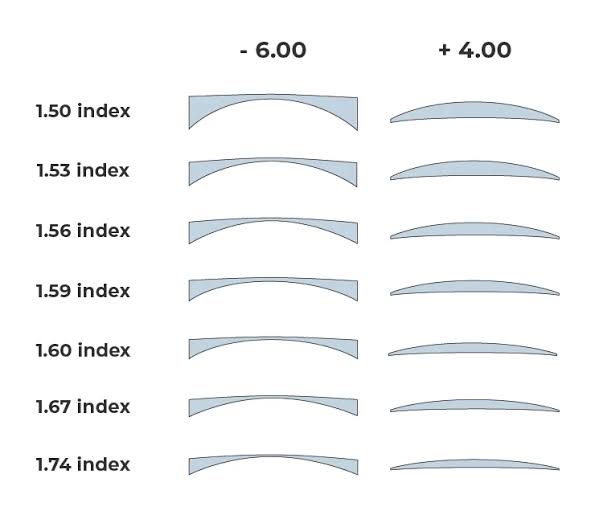
- CR-39 (Standard Plastic): This is the standard plastic lens material. It is lightweight, has excellent optical clarity (Abbe number ~58), and is highly resistant to impact compared to glass. Its main disadvantage is a relatively low refractive index (1.50), meaning strong prescriptions will be thicker, and it scratches more easily than glass.
- Mid-Index and High-Index Plastics: For stronger prescriptions, high-index plastics are used to make lenses thinner and lighter. Materials like polyurethane and polythiourethane (e.g., MR-8, MR-7, MR-10) incorporate sulfur to increase the refractive index (1.60 to 1.74+). While they reduce edge thickness significantly, higher-index materials generally have lower Abbe numbers, which can increase the risk of chromatic aberration for some wearers .
- Polycarbonate (PC): Known as "space lenses," PC is the most impact-resistant material available, used in safety glasses and sports goggles. It is naturally lightweight and blocks UV rays. However, its low Abbe number (around 30) results in lower optical quality (more chromatic aberration), and it is relatively soft, requiring a scratch-resistant coating.
Trivex: Trivex is a newer material that offers a compromise between PC and standard plastic. It has excellent impact resistance (though slightly less than PC), is lightweight, and has a significantly higher Abbe number than PC, providing better optical clarity.
Summary Table
| Material | Typical Index | Key Advantage | Key Disadvantage |
|---|---|---|---|
| Glass | 1.5 – 1.9 | Best scratch resistance & optics | Heavy; can shatter |
| CR-39 | 1.50 | Good optics; lightweight & safe | Thicker for high prescriptions |
| High-Index Plastic | 1.60 – 1.74+ | Thinnest option for high prescriptions | Lower Abbe number (more color fringing) |
| Polycarbonate | 1.59 | Maximum impact resistance; very light | Soft (scratches easily); lower optics |
| Trivex | 1.53 | Good impact resistance; better optics than PC | Not as thin as high-index materials |